Expansion and Enterprise Partnerships Building a Human-Created, Low-AI-Risk Royalty-Free Music Ecosystem
TRACKS Begins Operating One of Japan’s Largest Free BGM Platforms “DOVA-SYNDROME,” Strengthening Corporate Partnerships and Global Expansion
Providing a royalty-free music platform with lower AI-related risks through human-created sound sources
TRACKS Inc. (Head Office: Chiyoda-ku, Tokyo; CEO: Yuichi Miyagawa; hereinafter “TRACKS”) has officially taken over the operation of one of Japan’s largest free background music (BGM) platforms, “DOVA-SYNDROME,” from its founding composer-administrator. The company began operating the platform as a corporate entity on March 1, 2026.
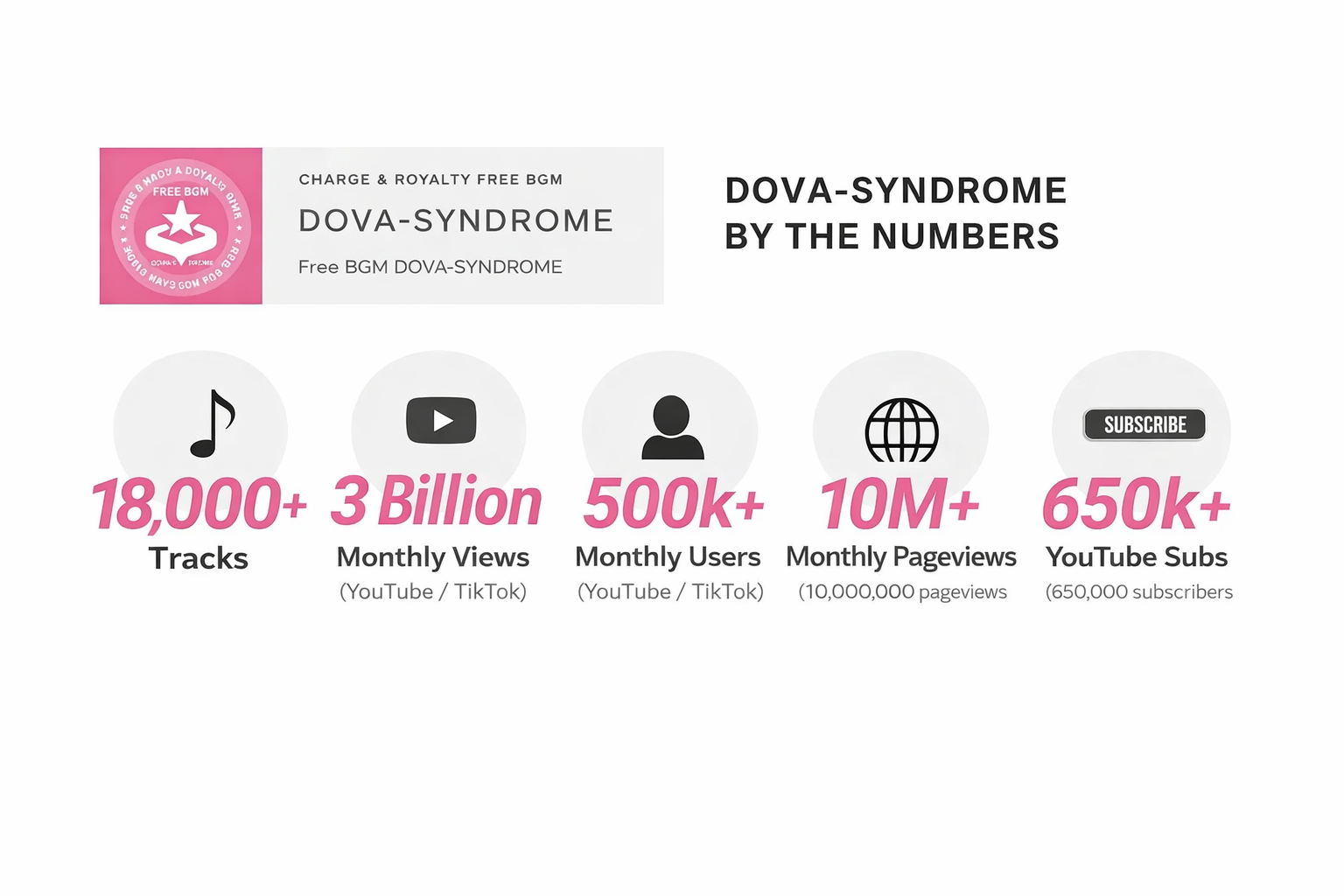
DOVA-SYNDROME has long served as a platform connecting music composers and content creators, and has grown into one of Japan’s largest and globally used free BGM libraries. The platform hosts more than 18,000 music tracks, with videos using its music sources generating over 3 billion monthly views on platforms such as YouTube and TikTok. The website attracts more than 500,000 monthly users, and its official YouTube channel has over 650,000 subscribers.
While preserving the platform’s philosophy and culture, TRACKS will continue operating DOVA-SYNDROME without changing its existing usage licenses or participation requirements for composers. At the same time, the company will strengthen its operational structure and introduce updates for future growth.
Enhanced reliability through corporate management
With the transition to corporate operation, DOVA-SYNDROME aims to provide an even more stable and trustworthy environment for both users and composers. This includes building a long-term service foundation, clarifying policies related to rights and platform management, and improving support systems for inquiries and business collaborations.
A royalty-free music pool with lower AI-related risks, based on human-created works
DOVA-SYNDROME’s participation policy requires that all music tracks be created directly by composers through their own creative processes and not generated by artificial intelligence. This approach reflects a commitment to protecting creative culture while also helping companies and platforms reduce potential copyright risks. As the use of AI-generated content expands globally, DOVA-SYNDROME will continue to maintain a clear policy centered on human creativity, providing a reliable and accessible library of free music resources.
Future initiatives: AI-powered search, B2B collaboration, and data utilization
Following the operational transition, TRACKS has begun developing and testing AI-powered music search features, enabling users to find tracks more intuitively using natural language descriptions of mood, atmosphere, or usage scenarios.
The shift to corporate management also allows TRACKS to pursue broader collaborations with companies and organizations. Planned initiatives include integrating music into video and audio platforms, exploring joint data analysis related to music usage, co-organizing events and content projects, collaborating with educational and media institutions, and launching international expansion projects.
DOVA-SYNDROME is more than a music distribution website; it is a platform where free BGM composers, users, music works, and real-world usage data continuously converge. Leveraging this foundation, TRACKS aims to create new revenue opportunities and exposure channels for composers as a key focus for the platform’s next phase.
Looking ahead
TRACKS is committed to supporting an ecosystem where free BGM is not only accessible but also easy to use, reliable, and continuously adopted. The company hopes to build the next phase of DOVA-SYNDROME together with the composers who have supported the platform, the users who rely on its music every day, and companies and organizations exploring new collaborative initiatives.
TRACKS welcomes inquiries from organizations interested in platform integrations, data partnerships, joint event planning, and global expansion initiatives.
Providing a royalty-free music platform with lower AI-related risks through human-created sound sources
TRACKS Inc. (Head Office: Chiyoda-ku, Tokyo; CEO: Yuichi Miyagawa; hereinafter “TRACKS”) has officially taken over the operation of one of Japan’s largest free background music (BGM) platforms, “DOVA-SYNDROME,” from its founding composer-administrator. The company began operating the platform as a corporate entity on March 1, 2026.
DOVA-SYNDROME has long served as a platform connecting music composers and content creators, and has grown into one of Japan’s largest and globally used free BGM libraries. The platform hosts more than 18,000 music tracks, with videos using its music sources generating over 3 billion monthly views on platforms such as YouTube and TikTok. The website attracts more than 500,000 monthly users, and its official YouTube channel has over 650,000 subscribers.
While preserving the platform’s philosophy and culture, TRACKS will continue operating DOVA-SYNDROME without changing its existing usage licenses or participation requirements for composers. At the same time, the company will strengthen its operational structure and introduce updates for future growth.
Enhanced reliability through corporate management
With the transition to corporate operation, DOVA-SYNDROME aims to provide an even more stable and trustworthy environment for both users and composers. This includes building a long-term service foundation, clarifying policies related to rights and platform management, and improving support systems for inquiries and business collaborations.
A royalty-free music pool with lower AI-related risks, based on human-created works
DOVA-SYNDROME’s participation policy requires that all music tracks be created directly by composers through their own creative processes and not generated by artificial intelligence. This approach reflects a commitment to protecting creative culture while also helping companies and platforms reduce potential copyright risks. As the use of AI-generated content expands globally, DOVA-SYNDROME will continue to maintain a clear policy centered on human creativity, providing a reliable and accessible library of free music resources.
Future initiatives: AI-powered search, B2B collaboration, and data utilization
Following the operational transition, TRACKS has begun developing and testing AI-powered music search features, enabling users to find tracks more intuitively using natural language descriptions of mood, atmosphere, or usage scenarios.
The shift to corporate management also allows TRACKS to pursue broader collaborations with companies and organizations. Planned initiatives include integrating music into video and audio platforms, exploring joint data analysis related to music usage, co-organizing events and content projects, collaborating with educational and media institutions, and launching international expansion projects.
DOVA-SYNDROME is more than a music distribution website; it is a platform where free BGM composers, users, music works, and real-world usage data continuously converge. Leveraging this foundation, TRACKS aims to create new revenue opportunities and exposure channels for composers as a key focus for the platform’s next phase.
Looking ahead
TRACKS is committed to supporting an ecosystem where free BGM is not only accessible but also easy to use, reliable, and continuously adopted. The company hopes to build the next phase of DOVA-SYNDROME together with the composers who have supported the platform, the users who rely on its music every day, and companies and organizations exploring new collaborative initiatives.
TRACKS welcomes inquiries from organizations interested in platform integrations, data partnerships, joint event planning, and global expansion initiatives.